
Marketers still carry around a mental model of billboard advertising that’s about seven years out of date.
Big screen on a highway. Maybe a rotating slide. A QR code if someone was feeling ambitious.
That picture is wrong. And the gap between perception and reality is costing marketing teams real opportunity.
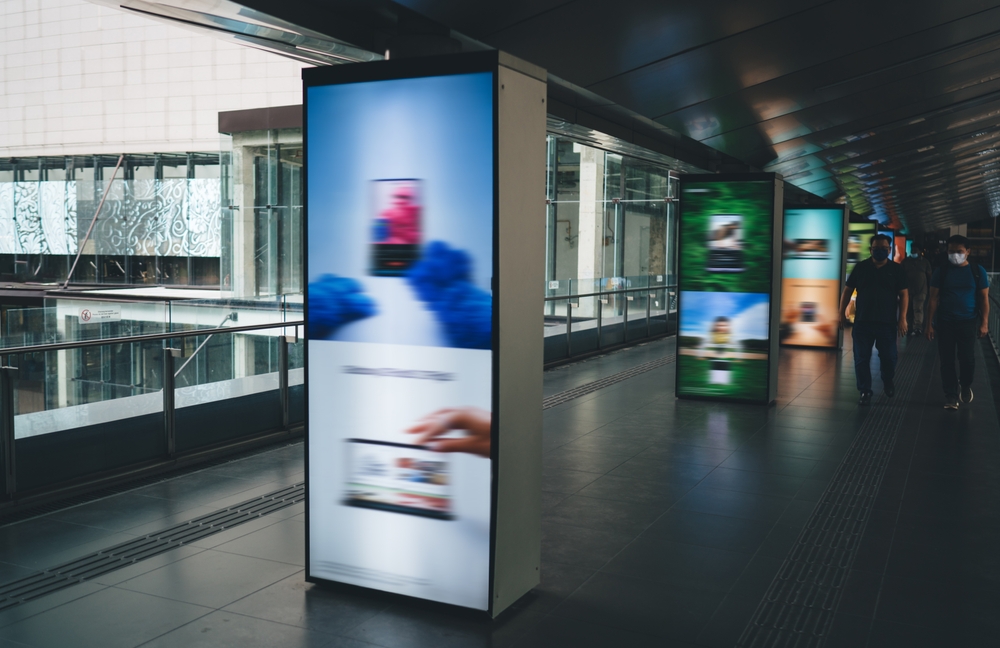
Today, digital out of home advertising spans airports, transit stations, office lobbies, gas station screens, elevators, street-level kiosks, and retail environments.
But the way most brands buy it hasn’t caught up to what the channel can actually do.
And that tension between what’s possible and what’s practiced is where the most interesting conversation in OOH is happening right now: the convergence of data and creative, and why neither one works without the other.
The science: a data layer most marketers don’t know exists
OOH inventory is massive, fragmented, and increasingly programmable. You can buy based on audience composition, daypart, geography, weather triggers, and proximity to specific locations.
You can launch in days, not months (especially in DOOH).
But the industry was not built around data. It was built around relationships, inventory, and rate cards. Vendors make money when you buy their units, not when you reach the right people. That incentive structure has never rewarded precision, so the industry never developed it.
That’s the system most marketers are still buying inside. And it’s the reason so many OOH campaigns get built on gut feel: the rep you know, the billboard you’ve always used, the market that feels right.
Programmatic OOH changes the equation
Programmatic digital out of home lets you layer audience intelligence onto the planning process before a dollar gets spent. You can map your ICP to real-world environments, identify where they actually live, work, commute, and congregate, and build a media plan around that answer rather than a vendor’s available inventory.
The numbers back this up. Studies have found that adding OOH to digital campaigns lifted incremental ROAS by roughly 80%. Meanwhile, OOH alone delivered a median iROAS around 2.6. U.S. billboards deliver an average ROI near 497% with CPMs in the low single digits, making them one of the lowest-cost channels for reaching large audiences at scale.
The confidence problem data actually solves
When a marketer says “I can’t measure this,” what they’re usually saying is “I can’t defend this internally.” The measurement objection is a confidence objection.
And the answer to a confidence objection isn’t a post-campaign dashboard.
When you know exactly where your ICP is, why you’re placing where you’re placing, and what the strategy behind the buy actually is, the investment becomes defensible before you launch. Better planning gives you more confidence than any dashboard.
That’s the science of digital billboard advertising based on thousands of campaigns.
And it’s what closes what we call the Brand Confidence Gap: the distance between believing OOH works and feeling confident enough to spend on it.
The Brand Confidence Gap is the distance between whether this marketer, at this company, can make this investment and feel good about it. Data-driven planning answers that question before the campaign goes live.
The art: why creative still decides who wins
Data can put your ad in the right place at the right time. It cannot make anyone care.
This is where digital billboard advertising diverges from almost every other programmatic channel. A display ad lives inside a browser and social ads live inside a feed. Both compete for attention in environments designed to scroll past them.
OOH lives in the physical world, where attention is earned by the environment, not interrupted by the format.
Attention is the asset
The data on attention bears this out.
OOH wins attention compared to digital ads.
About 65% of consumers report searching online after seeing an OOH ad, and roughly 40% say they visit a website or search for a brand within minutes of exposure.
That kind of immediate behavioral response is almost unheard of in traditional brand channels.
Creative quality is the differentiator
The brands doing DOOH well are treating the screen as a storytelling canvas, not a media impression. They’re designing for the specific environment the ad will appear in.
A transit station screen calls for something different than an airport terminal.
A street-level kiosk in a tech corridor has a different context than a highway digital board outside a conference venue.
Surveys show about 80% of consumers say they are likely to take action after seeing engaging OOH creative. The emphasis is on “engaging.” That means creative built for the environment, designed with cultural relevance and contextual awareness.
None of that can be automated.
And as AI makes digital creative faster to produce and harder to differentiate, the physical world becomes one of the last places where craft and originality still compound.
Why art without science is a gamble (and science without art is wallpaper)
Here’s where most DOOH advertising strategies break down. Marketers tend to over-index on one side.
The data-only trap
The performance-minded buyer treats digital out of home advertising like another programmatic channel. They optimize for impressions and CPMs, pick placements based on audience data alone, and repurpose a LinkedIn ad for the screen.
The targeting is smart. The creative is forgettable. The campaign technically reached the right people, and none of them remember it.
The instinct-only trap
The brand-minded buyer goes the other direction. They pick a high-visibility location on instinct, invest in bold creative, and hope the right audience sees it. The work is strong yet placements are decided randomly.
The campaign might land with exactly the right people, or it might run for six weeks in a market where the ICP barely exists.
Why neither approach survives alone
Data without strong creative produces wallpaper. Creative without data targeting produces expensive guesswork.
The OOH industry has historically rewarded the second approach, because the channel was built before the data layer existed. Vendors sold locations, not audiences.
The relationship between the buyer and the rep determined where the ad went, and creative quality determined whether anyone noticed. That was the whole model.
Programmatic OOH adds the other half. But adding data to the planning process doesn’t mean creative becomes less important. It means creative becomes more important, because now you know exactly who’s going to see it.
What the marriage looks like in practice
A DOOH advertising strategy that brings both sides together follows a specific sequence.
Start with audience intelligence
Ask:
Where does your ICP actually live, work, and move?
What markets have the highest concentration?
What environments put your brand in front of the right people in the right context?
This is the planning layer that makes the campaign defensible before a dollar gets spent.
Layer in contextual triggers
Daypart targeting so the ad runs when your audience is most likely to be present. Weather-based triggers for campaigns where context matters. Event proximity for conference and trade show surround campaigns.
Conferences and trade shows are a particularly strong proof point for the art-meets-science model.
They concentrate high-intent decision makers in a single geography, which makes the data side straightforward. And the environmental context, surrounded by competitors, walking between sessions, processing new information, creates a canvas where strong creative has an outsized effect.
The Legitimacy Signal
OOH in this context produces something beyond awareness. It produces what we call the Legitimacy Signal.
Every B2B company operates inside an ecosystem: investors who need to feel like they backed a winner, candidates deciding whether to join, partners who want to be associated with something credible, existing customers who need ongoing reassurance, competitors’ employees who notice.
A billboard in the right place at the right time ripples through that ecosystem in ways that are impossible to trace and impossible to ignore.
If you see a paid ad, you don’t know whether a company is credible. If you see a billboard, it signifies they are.
Build creative for the environment
Then, and only then, comes the creative. And the creative gets built for the specific environment, not adapted from another channel. A screen in a tech office lobby calls for a different message than a wallscape outside a conference venue.
A transit ad in a commuter corridor has different dwell time than a highway digital board at 65 miles per hour. The format, the copy length, the visual approach, even the color palette should reflect where the ad actually lives.
Close the Execution Gap
This is also where the Execution Gap comes in. The Execution Gap is the distance between believing in OOH and being able to run a great campaign.
Even when a marketer has the conviction and the data to back the buy, the channel fights back. Inventory is fragmented across hundreds of vendors. Formats vary wildly. Lead times are long and unforgiving.
A single campaign in a single city can mean coordinating with a dozen or more vendors, each with their own contracts, specs, and timelines.
The science tells you where to place. The art tells you what to say. But if the execution is a mess, neither one matters.
Closing the Execution Gap is what makes the art-meets-science model actually work at scale. One point of contact. One media plan. One team that knows the inventory, the formats, the lead times, and the gotchas.
Without that, even the best-planned campaign gets bogged down in logistics before the creative ever goes live.
The advantage that compounds
Digital billboard advertising is moving in one direction: toward more data on the planning side and more creative ambition on the execution side. The marketers who figure out how to work both levers, who treat the science as the foundation and the art as the differentiator, are building an advantage that compounds over time.
Because OOH rewards the combination in a way that purely digital media never will. In a feed, everyone has the same canvas.
In the real world, placement and creative interact in ways that are specific, contextual, and unrepeatable.
The marketer who gets both right doesn’t just run a campaign. They build a presence. And presence, once established, is very hard for a competitor to take away.