
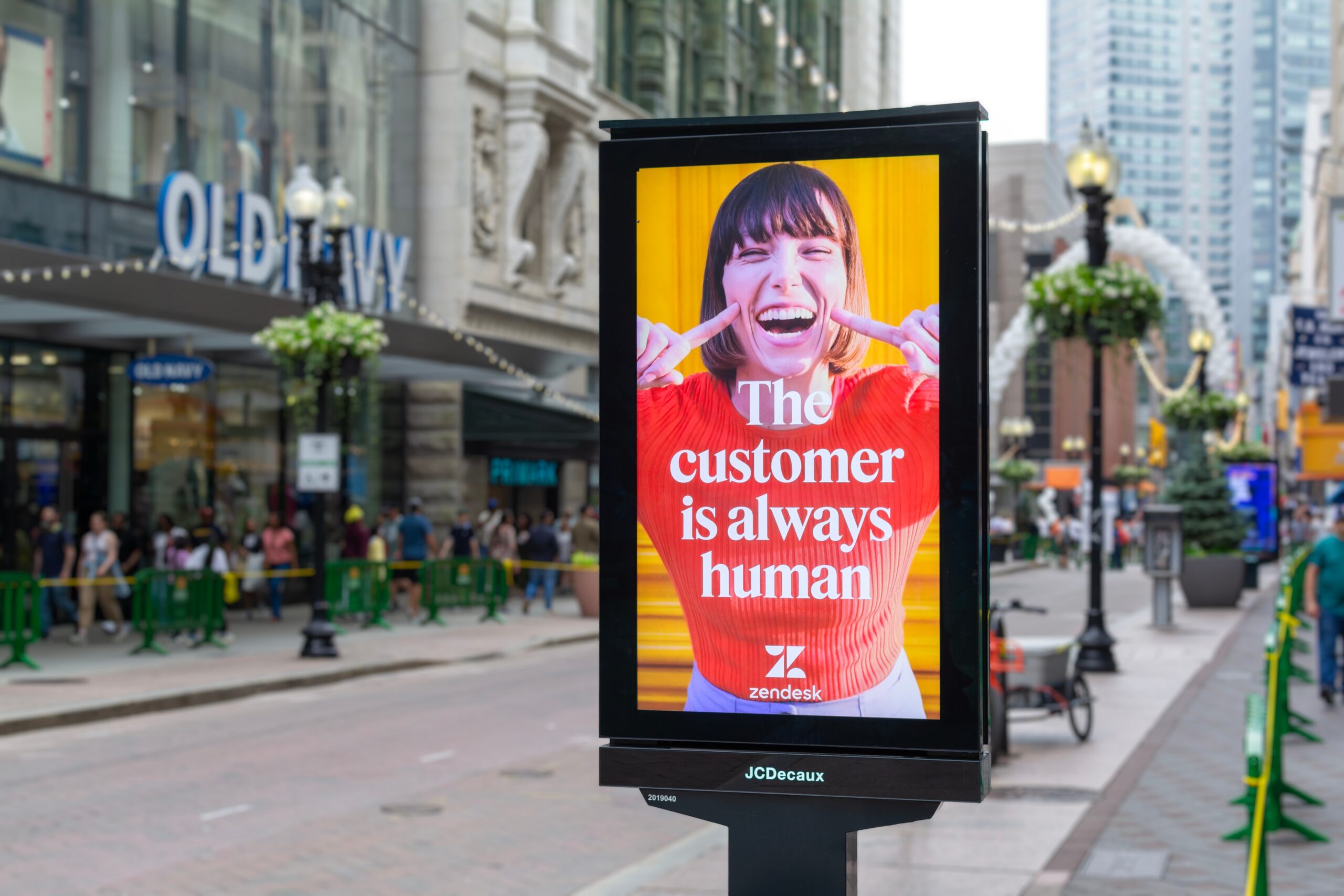
(…and how to build outdoor advertising into your marketing plan)
The average person sees somewhere between 4,000 and 10,000 ads a day, and almost all of them happen on a screen.
That statistic has been quoted for years, and the number keeps climbing. Every app, every feed, every inbox is now an advertising surface. Every pixel of attention is auctioned.
Inside that environment, brands are competing for a millisecond of eye contact against every other brand, every creator, every notification, and every piece of content a person has opted into. The math of attention on screens has gotten worse every year. And yet most B2B media plans keep pouring more money into the same digital channels, hoping that a better creative or a sharper targeting string will change the result.
It will not. The environment is the problem. And the environment out there, in the real world, is fundamentally different.
Screens are the most crowded media environment in history
When a prospect sees a LinkedIn ad, that ad is surrounded by six other ads, a news headline, a recruiter message, and a notification from their calendar. The attention it captures, if any, is fractional and distracted. Ad recall from digital impressions has been declining for years, and the industry knows it. Every new targeting feature is a response to the same underlying problem: nobody is looking.
A digital screen on the MBTA wall at rush hour does not compete with any of that. It competes with the road, the other cars, and maybe a podcast. The moment of attention is longer. It is repeated. It is encountered in a context the viewer is not trying to escape from. That difference in environment is why OOH impressions behave differently from digital impressions, even when the raw reach numbers look similar.
This is not a claim that billboards are better than paid social. It is a claim that they are doing a different job. Paid social captures demand that already exists. Real-world advertising builds the brand recognition that makes demand possible in the first place.
Why physical presence compounds
There is something specific that happens when a person sees a brand in the physical world. It registers as more real than a digital ad. You can see a paid ad a dozen times and still wonder if the company behind it is legitimate. You see a billboard once and the question goes away. A company with a wallscape in SoMa or a wrap at JFK is not a pop-up. It is a business.
That perception ripples through a brand’s entire ecosystem. Investors notice. Candidates mention it in interviews. Existing customers feel reassured. Competitors’ employees quietly update their sense of who the players are in the category. None of those people will fill out a form. All of them are making decisions about you.
For B2B brands in particular, this ecosystem effect matters more than most media plans account for. A $30,000 deal that starts six months after a prospect saw your billboard will never get attributed to the billboard. But the sales conversation it enabled could not have happened without it.
The Execution Gap (and why it stops most marketers)
If physical advertising is so valuable, why is it still underused?
Because it is hard to run. That is the honest answer, and the OOH industry does not talk about it enough.
A single B2B campaign in a single city often requires coordinating with a dozen or more vendors. A wallscape needs creative four weeks out. A digital unit has different specs. An airport has its own buying process. A transit wrap has another. Lead times are long and unforgiving, and most of the vendors you call will try to sell you what they have in stock, not what actually fits your plan.
The industry was built for full-time media buyers at large agencies who usually have long-standing connections. This is usually not the case for a VP of Marketing who has five other channels to manage and needs an answer by Friday. That mismatch (the Execution Gap) is what keeps most marketers out of the channel. Not belief. Logistics.
How to close it
Closing the Execution Gap is the unglamorous part of real-world advertising, and it is where a good partner earns their fee. The pattern that works looks like this:
One point of contact for the whole plan. A marketer should brief once and get back a complete media plan that spans every vendor and every format, priced together and reasoned through as a single campaign. No spreadsheet of seventeen quotes.
Audience data at the front end. Before any inventory gets selected, the ICP should be mapped to real-world environments. That map drives the buy. Placement decisions flow from it. This is what separates a modern OOH plan from a rate-card-and-relationship plan.
Creative specs and timelines handled centrally. Different formats have different production requirements. That coordination should happen in the background, not on the marketer’s desk.
Clean reporting tied back to the original plan. Impressions, reach, placement performance, and any available lift signals, delivered in a format a marketer can walk into a QBR with.
When those four pieces are in place, OOH stops being a project and starts being a channel. It can run on the same cadence as the rest of the media plan, which is when the compounding effects actually start to show up.
How to build real-world advertising into a modern media plan
Start with what the channel is good at. Real-world advertising is exceptional for brand building, for geographic concentration around a specific market or account list, and for moments that deserve visibility: funding announcements, product launches, conference weeks, category repositioning.
A useful mental model is to treat OOH as the saturation layer. Paid search and paid social capture the demand that exists. OOH makes sure the demand exists in the first place, and that when a prospect sees your digital ad later, they already know who you are.
Tie placements to your highest-value geographies. If 70% of your ARR comes from ten metros, that is where real-world advertising belongs. Concentrate spend rather than spreading it thin. A wallscape that runs for eight weeks in the right zip code will do more for brand equity than a national campaign that flickers across markets where your ICP does not live.
Plan for repetition, not reach. Real-world advertising works when people see it more than once. Flight length matters more than a big one-week burst for most B2B brands.
And integrate it with everything else. The OOH campaign that runs during the same weeks as your funding announcement, your conference sponsorship, and your paid LinkedIn push will produce outcomes none of those channels could produce alone.
The shift worth making
The attention economy on screens has reached the point where more digital spend produces less digital impact. Real-world advertising is not a nostalgia play against that trend. It is a structural response to it. Physical environments offer a quality of attention that screens cannot replicate, and the brands that build presence there will keep the equity that brands relying only on feeds cannot.
The channel is harder to run. That is the honest part. But the payoff, for brands willing to plan well and execute with a real partner, is a level of brand gravity that is hard to buy any other way.