
Somewhere on your calendar is a conference where a few thousand of your best-fit buyers will spend three days in the same square mile.
And the plan, if there is one, is a 10×10 booth in a hall with 400 identical ones. Conference advertising exists because that math has never made sense. The people you want to reach spend maybe six hours on the expo floor and roughly seventy in the city around it.
This post lays out the full playbook. Conference advertising means surrounding the host city with out-of-home placements timed to the event, planned around your attendee profile rather than the organizer’s sponsorship menu.
Why conference advertising beats the booth for share of attention
The economics of the expo floor keep getting worse.
Sponsorship tiers climb every year while the budgets funding them don’t. Forrester found that 69% of B2B event leaders saw budgets stay flat or decrease, which means most teams are paying more for the same crowded hall.
And it is crowded. Inside the venue, every brand has the same tote bag, the same lanyard logic, the same 30-second pitch to someone speed-walking to a session. Attendees came to learn, and 71% say in-person B2B conferences are the most effective way to learn about new products.
Your buyers are paying attention
The problem is that inside the hall, they’re paying attention to 400 brands at once.
Outside the hall, the competition mostly disappears. The airport wall, the transit corridor, the billboard over the coffee line: these placements reach the same attendees with far less noise. And they carry a signal the booth can’t.
A brand at booth 1147 looks like a vendor. A brand across the skyline of the host city looks like a company that’s winning. Investors at the event notice. Candidates notice. The analysts and press walking to their next briefing notice.
That perception ripples well beyond the attendee list, which is a big part of why out-of-home advertising keeps pulling budget from channels that only reach one audience at a time.
So the case is straightforward. The next question is what this actually looks like in practice.
What is conference advertising?
Conference advertising is out-of-home media placed across a host city and timed to an event, targeting the people attending it.
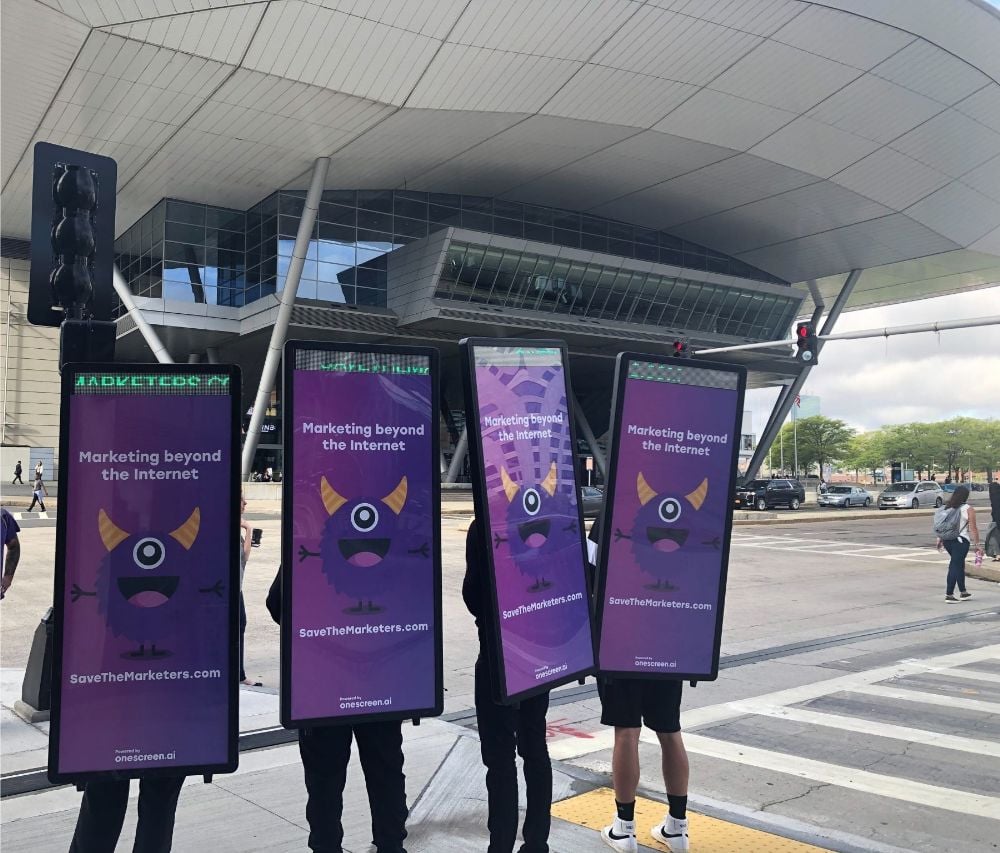
It covers billboards, airport displays, transit ads, street-level units, hotel-adjacent placements, and mobile billboard trucks. Event advertising like this runs entirely outside the organizer’s sponsorship program, which means no booth fee, no tier packages, and no rules about where your message can appear.
That independence is the point.
Trade show event marketing has traditionally meant buying whatever the organizer sells. Conference advertising flips the sequence: start with who’s attending, figure out where they’ll physically be, and buy media there.
The channel behind it is growing for a reason. U.S. out-of-home revenue reached a record $9.46 billion with 19 consecutive quarters of growth, and tech brands are among its fastest-expanding advertisers.
The format menu is wider than most marketers expect, spanning a dozen or more types of out-of-home advertising. Which ones matter for your event depends on where attendees will actually be. That’s where the placement map comes in.
5 places to reach attendees before they hit the expo floor
Attendees follow predictable paths during a conference week. Each stop on that path is a placement opportunity, and each one does a different job.
1. Airport arrivals set your first impression before anyone else gets a word in
For a national conference, most attendees fly in, which makes the arrivals corridor the first branded moment of their week. Airport placements work hardest here:
- Jet bridge and baggage claim displays catch attendees at their least distracted, waiting with nothing to read but the walls
- Arrivals-corridor units reach nearly 100% of flying attendees, a reach figure no session sponsorship can match
- Timing matters: arrivals-side inventory earns its cost in the two days before the event, not after
If your ICP is flying in from around the country, the airport is where the surround begins. Local and drive-in audiences need a different entry point.
2. Transit and rideshare corridors repeat your message every single day of the event
Attendees move between hotels and the venue at least twice a day, and repetition is what turns a glance into recall.
Corridor placements deliver it:
- Transit platform and station units near the venue reach the light-rail and subway crowd on a loop
- Wrapped vehicles and rideshare-visible street units cover the Uber-to-venue majority
- Digital street-level units let you rotate creative between morning and evening messages
By day three, an attendee who’s seen your brand six times on the same commute treats it as familiar. Familiarity is exactly what your sales team wants waiting for them.
3. Hotel clusters put your brand at the open and close of every conference day
Conference hotel blocks concentrate your audience into a few walkable blocks, and those blocks are cheap to own relative to the venue itself. The play:
- Street-level units and urban panels around the top three or four block hotels
- Coffee shop and breakfast-corridor adjacencies, since everyone caffeinates before the keynote
- Evening-hours digital placements near the restaurant and after-party zones where the real networking happens
The hotel cluster is also where the after-hours conversations happen, which means your brand shows up in the setting where deals actually start.
4. Venue-adjacent billboards own the walk to the badge line
Conference billboard advertising closest to the venue carries the most weight per impression, because context does half the work. Placement logic:
- A bulletin or wallscape on the main approach reads as a statement, and attendees photograph the bold ones
- Street furniture on the final walking blocks catches the badge-line queue at eye level
- Digital units near the venue can react to the event schedule, swapping creative between keynote days
These are also the placements competitors think of first, so inventory near major venues goes early. Lead time decides who gets them.
5. Mobile billboard trucks go wherever the schedule goes
Every placement above is fixed. The event isn’t, and a truck can follow it. Where mobile units earn their slot:
- Circling the venue during arrival and departure windows, then relocating to the party district at night
- Parking outside a competitor’s off-site event or a major after-party
- Carrying creative too bold or too targeted for a 4-week static commitment
Mobile billboard trucks are the flex layer of a conference plan, filling whatever gap the fixed placements leave. Together, these five zones cover the attendee’s entire day. Covering them well takes a plan.
How to plan a conference advertising campaign in 6 steps
A conference surround succeeds or fails in the planning stage, weeks before anything is printed. The steps run in a strict order because each one feeds the next.
Step 1. Define the attendee ICP before you look at any inventory
Inventory-first planning is how budgets get wasted on impressions that never reach a buyer. Start with who’s actually attending.
If the event draws your exact ICP, the whole city is fair game. If only a slice of attendees fit, that slice determines the map. This is also where a conference plan connects to a broader ABM strategy, since target accounts often cluster at the same handful of events.
Step 2. Map how attendees actually move through the host city
Attendee movement is knowable before the event starts, and movement data drives smart placement decisions.
Build the map from:
- The flight-in versus drive-in versus local split, which decides whether airports matter
- The hotel block list published by the organizer
- The walking and transit routes between hotel clusters and the venue
Two or three data points anchor the whole plan. More than that usually adds confusion, not precision.
Step 3. Match formats to timing windows, not to what’s available
Each placement zone peaks at a different moment in the event arc. Sequence the buy accordingly:
- Airport and highway units: heaviest in the days before and during arrivals
- Transit, street level, and hotel adjacencies: the during-event workhorses
- Venue-adjacent digital: keynote days and closing sessions
A placement in the right zone at the wrong time is money spent on empty sidewalks. Timing is the difference.
Step 4. Lock inventory early because lead times don’t negotiate
Out-of-home runs on physical logistics, and the calendar is unforgiving. Plan around:
- Static billboards and wallscapes: creative due roughly four weeks out, inventory reserved well before that
- Airport and transit programs: their own approval and production cycles, often the longest of any format
- Digital units: the most flexible, bookable closer to the event, and the fallback when static windows close
The best venue-adjacent inventory around major conferences sells out first. Whoever plans earliest wins the walk to the badge line.
Step 5. Build creative to each format’s spec, not one size fits all
A conference surround can involve a half-dozen formats, and each has its own production requirements. Get ahead of it:
- Design for distance and dwell time: a highway bulletin gets seven words, a transit platform poster can carry more
- Produce every required spec variant up front rather than resizing in a panic at deadline
- Keep one visual system across formats so six placements read as one campaign
The attendee should recognize the campaign at the airport and again at the venue without reading a word twice.
Step 6. Plan the arc: before, during, and after the event
The conference is a spike in attention, and the campaign should ride the whole curve. Structure the flight.
- Before: airport and market-wide units prime attendees as they arrive
- During: the full surround at peak weight
- After: a lighter sustained presence in your priority markets, so the brand attendees met at the event keeps showing up at home
The after phase is the one most teams skip, and it’s the cheapest brand recall you’ll ever buy. Six steps, one plan. Now for the part nobody puts in the deck.
The execution reality behind a one-city conference campaign
Everything above assumes the campaign gets executed cleanly, and that assumption deserves scrutiny. Out-of-home inventory is fragmented across hundreds of media owners. Every format has different specs, contracts, lead times, and approval processes. A single-city surround can mean coordinating a dozen or more vendors, each with their own paperwork and their own deadline.
Onescreen ran a New York campaign for Rippling that spanned 17 different vendors. One city, one campaign, 17 contracts, 17 sets of creative specs, 17 timelines.
Search how to promote a conference and no guide mentions that part, yet it’s the workload a marketer takes on the moment the surround becomes a side project next to five other channels.
Most teams facing that either hand the whole thing to whichever vendor rep called first, or scope the campaign down to one billboard and lose the surround effect that made the plan worth running. Neither outcome reflects a bad marketer. Both reflect an industry that was built for full-time media buyers and never adapted for the VP of Marketing who needs an answer by Friday.
This is the problem Onescreen was built to close. One point of contact, one media plan, one team that already knows the inventory, the lead times, and the gotchas around every major conference market. If there’s an event on your calendar where your buyers will be concentrated, talk with our team and we’ll map the surround before a dollar gets committed.
FAQ
How much does conference advertising cost?
Meaningful conference advertising campaigns typically start in the $15,000 to $50,000 range for a multi-week flight, based on Onescreen campaign planning experience. The spend scales with market, format mix, and duration. A single venue-adjacent digital unit costs far less, while a full airport-to-venue surround in a top-ten market runs higher. The efficient comparison is against the sponsorship tier you’d otherwise buy, which often costs as much for three days of shared attention.
Do I need to be a sponsor to advertise around a conference?
No. Event advertising in the host city runs on public inventory that has nothing to do with the event organizer. You can surround a conference you were priced out of sponsoring, or one where a competitor locked the exclusive tier. The only constraints are inventory availability and lead time, which is why early planning matters more than event-organizer relationships.
How far in advance should I plan a conference campaign?
Eight to twelve weeks before the event is the comfortable window, and earlier for major conferences in dense markets. Static formats need creative roughly four weeks before install, airport programs carry longer approval cycles, and the best venue-adjacent units sell out well ahead of big events. Digital inventory offers a shorter runway if you’re late, but the premium placements reward whoever committed first.
What formats work best for conference billboard advertising?
Venue-adjacent bulletins and wallscapes carry the most weight per impression because attendees see them in context, on foot, at low speed. Street furniture covers the final walking blocks at eye level, and digital units near the venue allow creative to change across keynote days. The strongest plans pair one statement placement with several repetition placements along the attendee commute.
How to promote a conference you’re hosting?
The same surround logic applies in reverse. Hosts use out-of-home to build registration in the months before the event and to make the host city feel taken over during it, which drives attendee word of mouth and next-year demand. Airport and transit placements welcoming attendees by name of event consistently rank among the most photographed moments of a conference week.
Does trade show event marketing work on a small budget?
Yes, if the budget concentrates instead of spreading. A focused plan built around one hotel cluster and the venue approach can outperform a scattered citywide buy at three times the cost. Small-budget surrounds work best at mid-size industry events where inventory is cheaper and a modest presence still reads as dominant.
How do I know the campaign worked without attribution reporting?
Confidence comes from the plan, not from a dashboard after the fact. When you know your ICP was concentrated at the event, you know where they moved, and you placed your brand along that path every day for a week, the exposure isn’t in question. Teams running conference surrounds consistently hear it back in sales conversations for months, in the form of “we saw you everywhere” moments that no attribution model would ever have captured.
Can conference advertising support an ABM program?
Directly. Conferences concentrate target accounts into one geography, which makes them the highest-density ABM moment on the calendar. Teams layer the surround with pre-booked meetings, direct outreach timed to the event, and digital retargeting in the weeks after, so the physical presence and the pipeline motion reinforce each other. Onescreen builds conference surrounds as part of broader ABM campaigns for B2B tech brands.