
Every billboard conversation eventually becomes a format conversation. Before you get there, it pays to know what you’re actually choosing between.
Static or digital? Fixed or mobile?
The answer should come from what the campaign needs, not what a vendor has available. Here’s a breakdown of all three formats, what they cost, and how to figure out which one fits your buy.
The three billboard formats, defined
Static billboard
A fixed printed display in a permanent location, showing one creative for the length of the buy. Static boards are the oldest and most common format in out-of-home advertising. Once the print goes up, the message stays until the end of the campaign. Think a 14×48 board on I-93 in Boston promoting a clothing or tech brand brand for 4 weeks straight.
Digital billboard
An LED screen in a fixed location that rotates multiple creatives and can be updated remotely. Digital billboards (also called digital OOH or DOOH) share display time across several advertisers, meaning your ad appears in rotation rather than exclusively. The tradeoff is flexibility: creative can change quickly, dayparting is possible, and lead times are shorter than print. Think a DOOH screen in Times Square running a retail brand’s lunch promotion from 11am to 2pm, swapping to a different creative after hours.
Mobile billboard
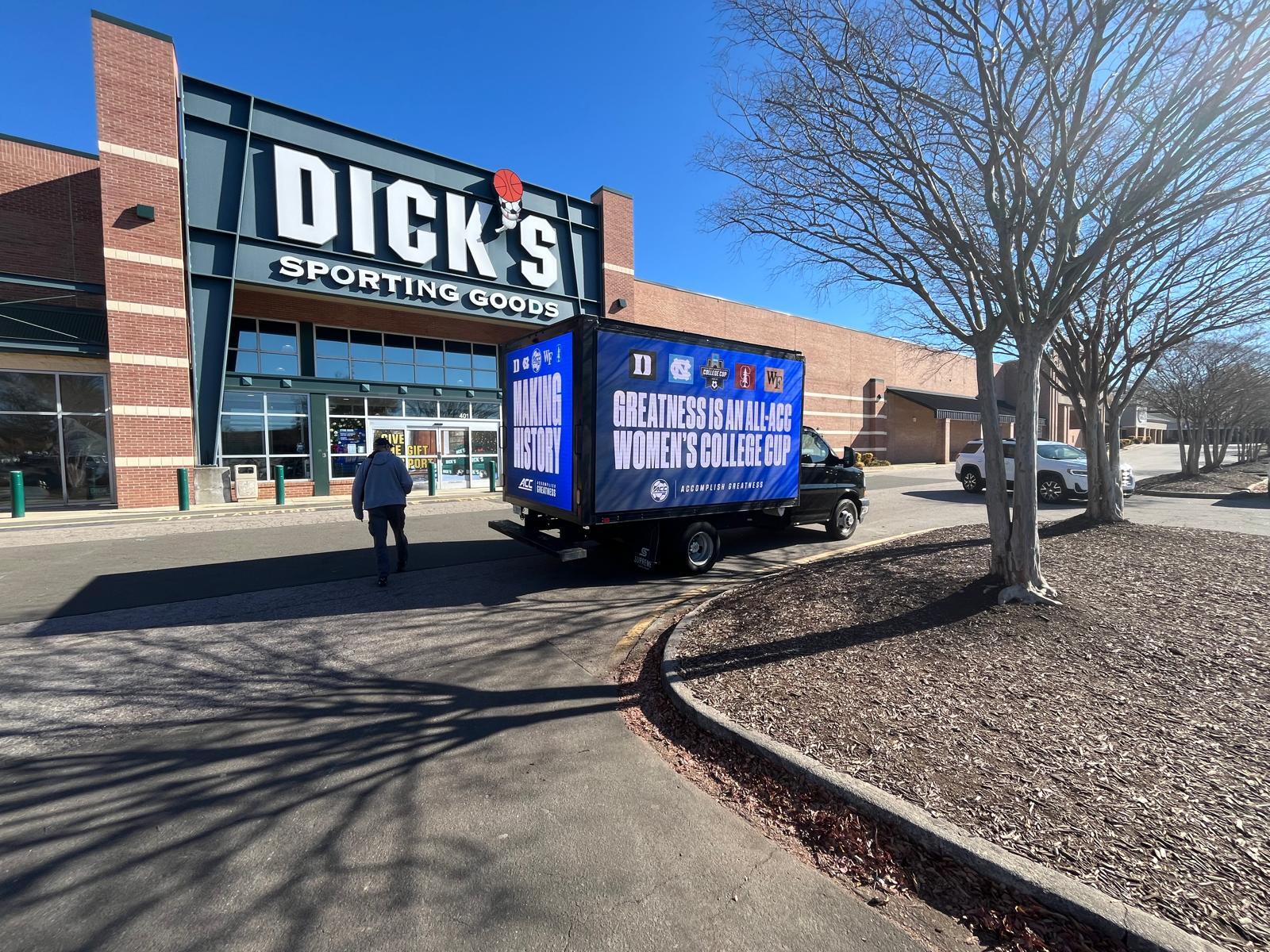
An ad mounted on a truck or trailer that travels a planned route to reach a specific audience in a specific place. Mobile billboards trade the permanence of a fixed location for precision, putting your creative exactly where you need it to be. Think a wrapped truck working the Seaport District during a Red Sox home stand, looping Congress Street and Northern Avenue while foot traffic peaks before first pitch.
Similarly, LED trucks can allow for more dynamic creative that can draw eyes. Because the screens are digital, brands can rotate multiple messages in a single route, run full-motion video, or update creative mid-campaign without reprinting anything. That flexibility opens up tactics static formats can’t match, like tailoring the message to the neighborhood the truck is passing through or timing specific creative to an event schedule.
Each format is built around a different priority: how long your message stays up, how quickly you can change it, and how exactly you can control where it lands.
How much does each billboard format cost?
Billboard costs vary enough by market, location, and format that any single cited number will mislead.
Rates for the same format can range from the low hundreds per 4‑week period in very small markets to the mid–five figures or more in top-tier metros and iconic locations. For instance, a static billboard on i-93 in metro boston will be around $15-$20K per month whereas that same sized billboard could be $70-90K per month on the 101 in the SF metro. Everything depends on market, location, visibility, and estimated impressions.
Here is how to think about the ranges and what drives them, with the understanding that any specific dollar figures should be validated against a current cost guide from vendors in your target advertising area.
Static billboard costs
Static billboards are typically priced by 4‑week period.
A roadside static board in a mid-size market might run somewhere in the low‑ to mid‑thousands of dollars for a four-week flight, while similar units in smaller markets can be materially lower and premium bulletins in major metros can push into the high‑four or even five‑figure range per 4‑week period.
Production costs for the printed vinyl are separate and typically add a few hundred dollars per creative for printing and installation combined, depending on size, vendor, and how many units you’re producing.
Digital billboard costs
Digital billboards are also priced by 4‑week period, but because display time is shared across multiple advertisers, the rate per advertiser is usually lower than a comparable static exclusive in the same location.
In smaller and mid-size markets, advertisers might see 4‑week packages in roughly the low‑ to mid‑thousands of dollars for a standard share of rotation, while high-traffic digital units in major metros and premium urban districts can range from the mid‑four figures up into the five‑figure range per 4‑week period, with the exact number driven by market, audience volume, and your share of the loop.
The variables that matter most are market size, traffic volume, and how many advertisers are sharing the rotation, as AGM’s pricing breakdown shows, along with whether you are buying broad all-day coverage or more efficient dayparted schedules priced to match the hours you actually run.
Mobile billboard costs
Mobile billboards are priced by day or by campaign.
Published day rates for a single truck typically fall somewhere in the high hundreds to low thousands of dollars per day, with smaller markets and simpler routes on the lower end and large metros, event-driven campaigns, or premium digital trucks on the higher end.
Multi-day campaigns in major markets will run higher overall, especially if you add extra hours, multiple vehicles, or complex route requirements, and the cost-per-impression tends to be higher than static or digital roadside units, MR’s rate data shows, but with more precise geographic targeting and route control.
When to choose a static billboard
Static is the right format when:
- The goal is sustained, always-on presence over a long flight.
- The placement itself carries weight, a marquee location with high daily traffic.
- The message is simple and does not need to change mid-campaign.
- The budget needs to stretch as far as possible on a cost-per-exposure basis.
- Broad market saturation matters more than precise audience targeting.
Static earns its place with repetition. A well-placed board seen by the same commuters every day for four to eight weeks does what a single digital impression cannot.
When to choose a digital billboard
Digital is the right format when:
- The campaign requires multiple creatives or messages running in the same location.
- Creative needs to change quickly, whether for a promotion or event.
- Dayparting matters, different messaging for morning commuters versus evening traffic.
- The flight is short and static lead times do not fit the timeline.
- Premium high-traffic digital locations align with the audience.
Digital also makes testing easier. Running two creatives in rotation and reading early performance signals is straightforward in a way that static does not allow.
When to choose a mobile billboard
Mobile shines when you need to be somewhere specific for a specific window of time. That makes it the right call for events and conferences, where your creative can meet attendees before they walk in the door. It works equally well for account-based marketing around a target’s office or campus, for markets where static inventory is thin or poorly positioned, and for campaigns with timelines too short for traditional lead times.
How to choose: a format decision framework
The wrong way to choose a billboard format is to start with what is available and work backwards. The right way is to start with your audience and your campaign goal, then pick the format that fits both.
A few questions that drive the decision:
- Where does my audience actually spend time, and when?
- Does my message need to change during the campaign, or is one creative enough?
- How long does this campaign need to run to be effective?
- Am I buying broad presence or targeting a specific moment?
Once those questions have answers, the format usually selects itself. Sustained presence in a high-traffic corridor points to static. A multi-message campaign with a short runway points to digital. A conference play or an ABM push around a target account’s zip code points to mobile.
This is where Onescreen helps the most.
Rather than browsing available inventory and reverse-engineering a rationale, the planning layer starts with audience data, identifies where your target profile concentrates, and matches format to moment before a single screen gets selected.
Static for presence. Digital for flexibility. Mobile for precision. Either way, the right answer always starts with the audience.