
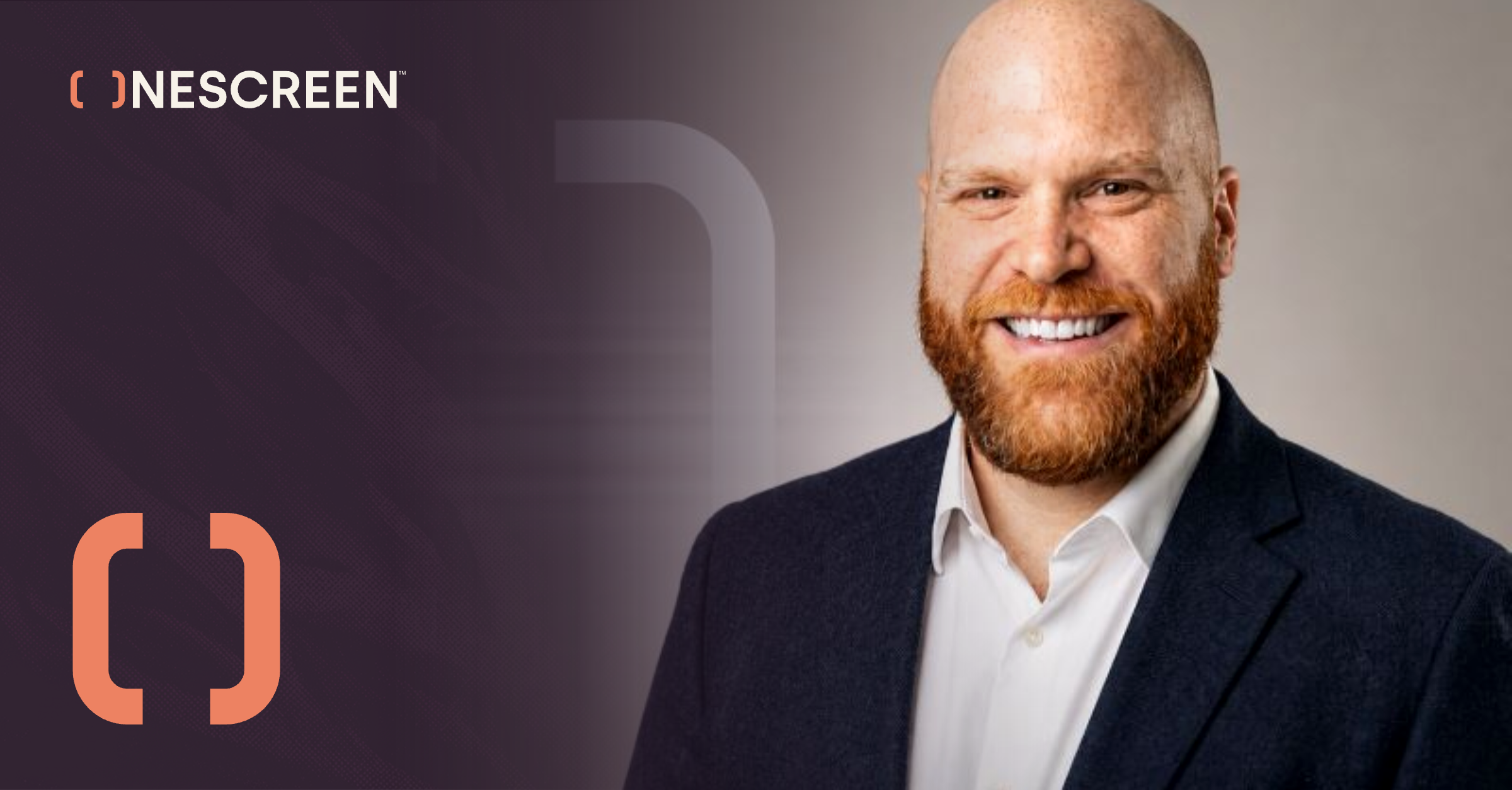
From retail media to real-world advertising, Onescreen’s new CEO shares his first impressions, the opportunities ahead, and why he believes OOH is at an inflection point.
What happens when a leader who helped shape the infrastructure behind retail media turns his attention to out-of-home advertising?
For Onescreen’s new CEO, Adam Skinner, the opportunity is bigger than billboards. It’s about fundamentally changing how brands discover, plan, buy, and measure real-world media.
Adam officially joined Onescreen as CEO on September 2, bringing extensive experience in retail media, advertising technology, and the infrastructure that makes complex media ecosystems easier to navigate.
His arrival comes at a pivotal moment for the industry. As more brands recognize the value of reaching audiences in the physical world, OOH is evolving from a traditionally fragmented channel into an increasingly measurable, accessible, and strategic part of the marketing mix.
Now, six weeks into the role, Adam is sharing his first impressions, what he’s learned about the company and its people, and where he sees the biggest opportunities ahead.
We also sat down with him for a deeper conversation about everything from AI-powered media planning to the future of retail media, the power of shared awareness, and why the next era of OOH will be built on better infrastructure.
A Note from Adam: My First Six Weeks at Onescreen
By Adam Skinner, CEO, Onescreen
On September 2, we announced that I was joining Onescreen as CEO.
My argument then was that retail media didn’t win because shoppers suddenly loved sponsored listings. It won because someone made scattered inventory easy to buy, made impressions comparable, and made outcomes provable.
Out-of-home has some of the best inventory in media, but it has never had that connective layer.
Six weeks in, I believe that more than I did on day one.
The demand is there. Brands are moving out-of-home into their standing budgets rather than treating it as a one-off. What holds the channel back is how hard it still is to plan, buy, and prove.
That’s an infrastructure problem, which is exactly the kind of problem I came here to solve.
I also didn’t want our direction to come from me alone.
Two weeks into the job, we brought the whole company together in Boston for three days. We looked hard at where we are, agreed on where we’re going, and decided what we’re betting on to get there.
I’m not going to lay out the plan here, but the themes won’t surprise anyone who knows my background: connecting real-world media to how brands and retailers already buy, making it simpler for the agencies who plan it, and raising the bar on how the channel proves it works.
I left Boston with a team that wrote the plan together and is focused on executing it.
What excites me most is that we aren’t starting from zero.
The team has already made real-world media plannable and accountable before a client spends a dollar. We recently passed our SOC 2 audit, we’re moving into a new Boston office, and we have real momentum with the brands and agencies we work with.
Our mission is to give growing brands the confidence to buy real-world advertising like the strategic channel it is.
I’ve never been more sure this is the right mission, or that this is the right moment.
I’ll share more as we build.
— Adam Skinner, CEO, Onescreen
Getting to Know Adam: Five Questions on the Future of OOH
Beyond his first impressions of Onescreen, we wanted to learn more about the thinking behind Adam’s decision to enter the OOH industry, the lessons he’s bringing from retail media, and how he envisions the next phase of growth.
Here’s what he had to say.
1. You’ve spent much of your career making retail media easier to buy and measure. What made you see the potential in out-of-home advertising?
Every digital channel I’ve worked on is built to reach an individual. A billboard reaches a room.
When a piece of physical media lands, it doesn’t just create awareness. It creates shared awareness.
Your prospect saw it, but so did their CFO, their board member, and the competitor pitching against you. And crucially, each of them knows the others saw it.
Economists call that common knowledge, and it behaves completely differently from private information. Retargeting is a whispered conversation. A placement outside someone’s office is a public one.
That distinction matters enormously in B2B, where purchasing decisions often involve committees of six or eight people.
You can reach all eight individually on LinkedIn and still be a name that one person has to champion from scratch. Reach them collectively, and you’ve changed what the meeting feels like before it starts. Nobody has to explain who you are.
That’s not incremental reach. It’s a different job.
One campaign that reframed my thinking was Burger King’s Whopper Detour.
It was celebrated as a brilliant mobile marketing stunt, using geofencing to steer people away from McDonald’s. But the real insight wasn’t mobile at all. It was geographic.
Burger King recognized that its competitor’s physical footprint was the targeting layer. The most valuable signal wasn’t someone’s browsing history; it was where they physically were.
Burger King Finland later brought that same concept to actual out-of-home placements outside McDonald’s restaurants in Helsinki.
The strategy worked because of where it happened.
That stuck with me. We’d spent years building elaborate digital technology to approximate something physical media does naturally.
I’d also spent much of my career making channels measurable, and somewhere along the way I’d absorbed the idea that anything unmeasured was probably unimportant.
That’s the wrong lesson.
Unmeasured and unimportant are two very different problems. Only one of them is ours to solve.
2. You’ve compared today’s OOH industry to retail media a decade ago. What’s the first thing that needs to change?
The impression. Unglamorous, but it’s the whole unlock.
Retail media didn’t win because the creative got better or because shoppers suddenly wanted more ads. It won because the industry agreed on a unit of trade.
Money doesn’t move at scale until buyers understand what they’re buying.
That’s the lesson OOH needs to take from retail media.
Today, buyers comparing inventory from different media owners can still find themselves comparing two different definitions of an impression, even when they’re presented as the same number.
There are industry standards, but standards only work when everyone applies them consistently.
Underneath that challenge is something even more fundamental: inventory metadata.
OOH supply is fragmented across media owners, platforms, and deal structures. The same asset can be described differently depending on who’s selling it.
You can’t build consistent measurement on inconsistent descriptions.
So the order matters: agree on the impression, make the inventory machine-readable, and let attribution follow.
The industry often starts with attribution because that’s what clients want to see. But it’s the part that can’t work properly until the foundation is in place.
3. Where do you see the biggest growth opportunities for Onescreen over the next 12–18 months?
Four areas stand out, and they’re all connected by an important lesson from retail media.
Retail media didn’t create an entirely new budget. It positioned itself alongside existing shopper and trade marketing investments and made itself a natural next step.
Channels that demand a brand-new line item can wait years for one. Channels that fit into an existing buying model can move much faster.
That’s how I think about our opportunities.
First, commerce and retail media. Physical retail still accounts for the majority of purchases, yet retail media investment is increasingly concentrated among a handful of major platforms.
Brands need additional ways to reach shoppers, and OOH offers something uniquely valuable: proximity to the physical point of purchase.
It can influence consideration on the way to the store, before a shopper ever reaches the aisle.
Second, CPG and FMCG brands. These marketers already think in terms of shoppers, purchase behavior, and retail environments. We don’t need to teach them an entirely new framework. We need to make OOH accessible within the one they already use.
Third, agency partnerships. Our ambition isn’t to be another vendor agencies remember to call. It’s to become the OOH layer within the media plans they’re already building.
Fourth, inventory connectivity. Expanding access to supply and describing it consistently is what makes the other three opportunities possible at scale.
The common outcome is that OOH stops being treated as a separate line item and becomes a natural part of the broader media plan.
That’s the future we’re working toward.
4. Onescreen is already bringing real-world media inventory into AI assistants through MCP. How do you see AI changing the OOH buying experience over the next year?
One of the things retail media got right was making itself buyable within the workflows marketers were already using.
It didn’t require planners to learn an entirely new discipline.
With MCP, we have an opportunity to take that even further.
Rather than forcing buyers into another interface, we can make real-world inventory discoverable through the AI assistants they’re already using.
But I want to be precise about what that means, because I think the industry is at risk of overclaiming what AI can do.
Right now, MCP is about discovery. It can help answer questions like: What inventory exists? Where is it? Who does it reach?
A planner could ask an AI assistant to identify Chicago billboards reaching Red Line commuters earning over $90,000 and get results grounded in real inventory rather than a confident guess.
That dramatically simplifies a process that previously required vendor decks and days of back-and-forth.
But discovery is not the same thing as a media plan.
Great OOH planning requires human context that a model doesn’t necessarily have: what a brand is trying to accomplish, which accounts its sales team is pursuing, how retail partnerships factor into the strategy, or why a seemingly perfect placement might actually be the wrong choice.
That judgment isn’t something we should be trying to eliminate. It’s where much of the value lives.
The bigger opportunity is connecting OOH to the rest of the marketing ecosystem.
OOH shouldn’t operate in isolation from onsite retail media, offsite advertising, or in-store campaigns. These channels should be coordinated around the same audiences, objectives, and calendars.
Onsite media reaches shoppers as they browse. In-store media reaches them at the shelf. OOH can reach them on the way there and on the way home.
When planned together, each channel makes the others more effective.
Looking a year ahead, I see two major shifts.
First, the brief becomes the interface. Instead of asking AI to pull a list of billboards, a planner might provide an audience, budget, campaign objectives, and existing retail media schedule, then ask for three strategic approaches.
Second, AI agents will increasingly compare inventory across suppliers. That makes machine-readable inventory a distribution channel in its own right.
Inventory that can’t be understood by an AI system may never even make it into consideration.
Of course, there’s a risk: AI can generate a very convincing media plan that’s completely invented.
Grounding AI in real inventory is the starting point, not the finish line.
The real value comes from what a great planner does with that information.
5. Onescreen works with B2B technology companies, fintech brands, and consumer marketers. As OOH matures, do you think these segments will eventually follow the same playbook?
The infrastructure converges. The buying motion doesn’t.
I’d bet on one platform and three playbooks.
Measurement standards, inventory data, planning tools, and buying infrastructure should be consistent across industries.
There’s no such thing as a B2B impression.
But the way different brands use OOH is genuinely different.
For B2B technology companies, OOH is often account-based. You’re trying to reach a relatively small, named audience, contract values are high, and success may look like a target account entering the pipeline rather than a broad reach metric.
Consumer brands are typically focused on reach and frequency across much larger audiences, often with a shorter path to purchase.
Fintech sits somewhere in between, with an additional layer of compliance that can shape the creative and planning process from the beginning.
There are two mistakes we need to avoid.
One is forcing every customer into the same playbook because it’s operationally convenient. That leads to campaigns that aren’t particularly effective for anyone.
The other is treating each segment like an entirely separate business, which sacrifices the benefits of shared infrastructure.
The discipline is knowing which parts of the process should be common and which genuinely need to be different.
Building What’s Next for Real-World Advertising
If there’s one theme that runs through Adam’s first six weeks and his vision for Onescreen, it’s that the next phase of OOH growth won’t be driven by attention alone.
It will be driven by accessibility, consistency, and confidence.
The opportunity is to make real-world advertising easier to discover, simpler to plan, more connected to existing marketing investments, and more accountable to business outcomes.
And with a growing team, expanding inventory connectivity, and new technology bringing OOH into the AI-powered workflows marketers already use, Onescreen is focused on helping make that future a reality.
The next chapter of OOH isn’t just about getting brands seen. It’s about making real-world media a natural, measurable part of how modern marketing works.
We’re excited to have Adam leading the way.
Want to learn more about where Onescreen is headed? Explore Onescreen and discover how we’re making real-world advertising more accessible for brands and agencies.